 Save
Save My sister called three days before Thanksgiving, panicked that she'd promised to bring something "show-stopping" to our family dinner but had no idea what that even meant. I found myself explaining over speakerphone how to shape sourdough into a turkey, and by the time we hung up, I realized I'd never actually made one myself. The next morning, I mixed flour and water, fed my starter, and set out to prove that a loaf of bread could be both delicious and beautiful enough to be the centerpiece before anyone took a knife to it. That project taught me that sometimes the best kitchen adventures start with someone else's panic.
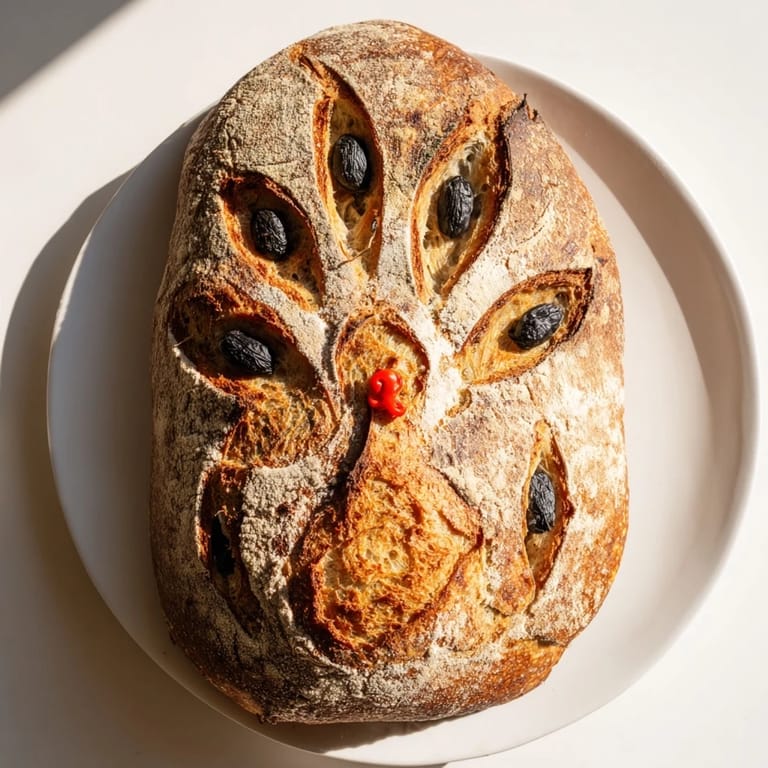
I remember sliding that first turkey loaf onto the hot stone and hearing the immediate sizzle of steam—my kitchen smelled like a European bakery for the next forty minutes. When I pulled it out, golden and crackling, my partner laughed because I'd accidentally made the wattle slightly lopsided, but somehow that made it more charming, more real. Serving it at our table felt different than serving regular bread; people hesitated before cutting into it, wanting to admire it first.
Ingredients
- Bread flour (500 g): Use a higher protein flour if you can find it; the gluten structure keeps your turkey standing proud and gives you that satisfying crust.
- Water (350 g, room temperature): Room temperature water works with your starter more gently than cold water, and the fermentation feels less rushed.
- Active sourdough starter (100 g at 100% hydration): If your starter is sluggish, feed it and wait until it doubles before using; a vigorous starter is everything.
- Fine sea salt (10 g): Don't skip this or reduce it; salt strengthens the dough and deepens flavor in a way nothing else can.
- Black olives or peppercorns: These become the eyes, and honestly, the personality of the whole bird lives in that tiny detail.
- Red bell pepper or dough scrap: The wattle is your chance to add color and play; don't overthink it.
- Egg wash (1 egg, optional): Brush it on for shine and help seeds stick, or use plant milk for that same gentle shine while staying vegan.
- Seeds (poppy, sesame, or flax): These scattered across the wings and tail mimic feathers and add a textural surprise.
Tired of Takeout? 🥡
Get 10 meals you can make faster than delivery arrives. Seriously.
One email. No spam. Unsubscribe anytime.
Instructions
- Rest the flour and water:
- Mix your flour and water in a large bowl until shaggy and combined, then cover and walk away for 30–45 minutes. This autolyse period lets the flour fully absorb water and develops gluten without any work from you.
- Bring in the starter and salt:
- Add your active starter and salt to the rested dough and mix until everything is evenly distributed. This might feel harder at first, but keep going until you can't see any dry flour.
- Stretch and fold your way to strength:
- Every 30 minutes for the next 2 hours, wet your hand, grab one side of the dough, stretch it up and fold it over the center, then rotate the bowl and repeat. You'll do this 3–4 times total, and each fold builds gluten structure without aggressive kneading.
- Let bulk fermentation work its magic:
- Cover the bowl and leave it at room temperature (around 21–23°C or 70–74°F) for 5–7 hours until the dough has roughly doubled and you can see bubbles breaking the surface. This is where the sourdough flavor develops and the dough becomes extensible enough to shape beautifully.
- Shape your turkey:
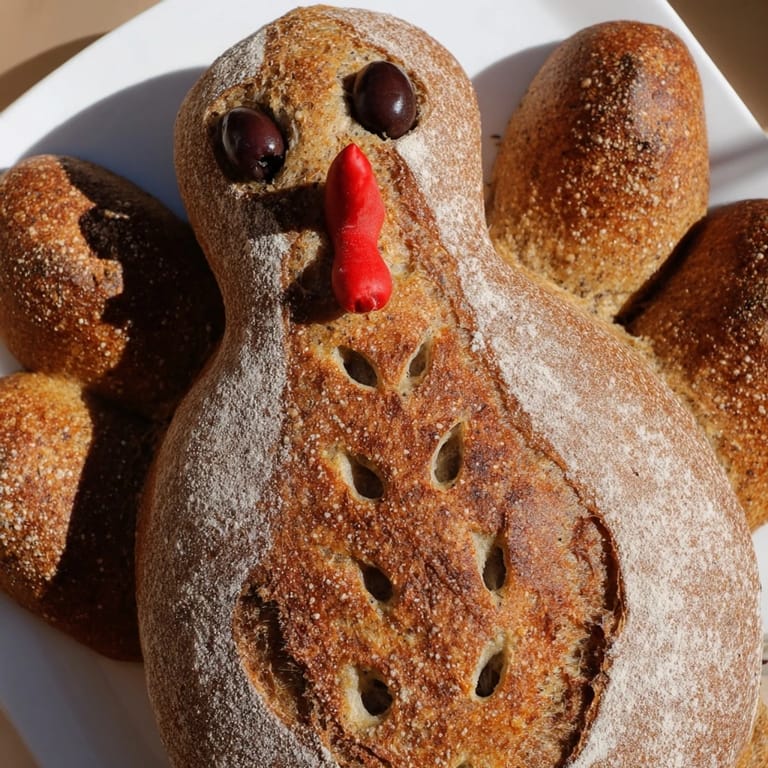
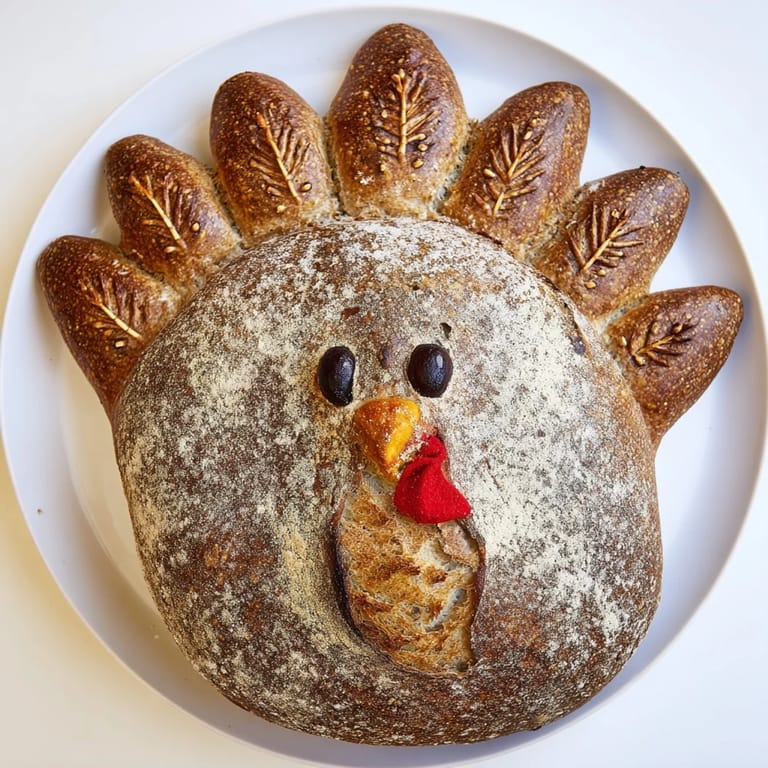
- Turn the dough onto a lightly floured surface and gently coax it into pieces: one large oval for the body, one smaller round for the head, and several teardrop shapes for tail feathers and wings. Use water as glue to attach the head to the body, then arrange the feathers in a fan.
- Add character with details:
- Score feather lines into the tail with a sharp knife or bread lame, press olive pieces or peppercorns into the head for eyes, and shape a tiny wattle from red pepper or a scrap of dough and nestle it under the head. These details are what transform bread into a turkey.
- Give it a final proof:
- Cover your assembled loaf and let it proof for 1–2 hours at room temperature until it's puffy but still holds its shape. You want it slightly risen but not over-proofed, or the oven spring will spread your feathers.
- Heat your oven like you mean it:
- Preheat to 230°C (450°F) with a baking stone or steel inside for at least 30 minutes. A truly hot surface is the difference between a pale loaf and a spectacular crackling one.
- Optional shine and texture:
- If using egg wash, brush it on just before baking and scatter your seeds over the wings and tail while the wash is still wet. If vegan, a light brush of plant milk gives a gentler golden color.
- Bake with steam, then without:
- Slide your turkey onto the hot stone and bake for 20 minutes with steam (use a pan of hot water on the bottom rack or spray the oven walls). After 20 minutes, reduce the heat to 200°C (400°F) and bake 20 more minutes until the crust is deep golden and the loaf sounds hollow when you tap the bottom.
- Cool before cutting:
- Transfer to a wire rack and let it cool completely before slicing. I know it's hard to wait, but cutting into warm bread collapses the crumb; cooled bread holds its shape and shows off that beautiful open structure.
 Save
Save I brought that lopsided turkey to a potluck, and three people asked for the recipe before they even tasted it. One friend said it felt wrong to cut into something that pretty, and another admitted she'd taken five photos before everyone convinced her to let us eat it. That moment, watching people pause and really look at bread instead of just consuming it, shifted something in how I think about cooking for others.
Why Sourdough for This Project
Sourdough's long fermentation creates a dough that's strong enough to hold a complex shape but still gentle to work with, and the natural sourness adds a savory depth that makes the bread memorable even after the novelty of the turkey shape wears off. Commercial yeast works faster and rises higher, but sourdough has a forgiving, flexible quality that feels less likely to collapse when you're asking it to defy gravity as an artfully arranged bird.
Timing and Temperature Flexibility
If your kitchen is cooler than 21°C, your bulk fermentation will stretch longer—maybe 8–10 hours instead of 5–7—and that's actually fine; cold fermentation often improves flavor anyway. On hot days, watch the dough more carefully; it might be ready in 4–5 hours, and rushing a bulk ferment that's clearly doubled is better than leaving it until it starts to collapse. Think of the timings as guidelines informed by visual cues, not rigid rules.
Variations and Flavor Additions
This dough is a beautiful canvas for herbs and seeds folded into the bulk fermentation; rosemary and thyme add an herbaceous warmth that pairs beautifully with cheese or soup, and adding them in the last fold means they stay flavorful instead of turning bitter. Some bakers add a touch of olive oil for tenderness, or a small amount of whole wheat flour for earthiness, but I'd introduce these one at a time on separate bakes so you understand how they change the dough's behavior.
- Mix in fresh or dried herbs during the final stretch-and-fold for even distribution and fresher flavor.
- Try scoring patterns that echo feathers more deeply, or add sesame seeds as you shape for a nuttier taste.
- If you make this for a holiday party, shape two smaller turkeys instead of one large one—they proof faster and slice more dramatically for guests.
 Save
Save There's something quietly magical about turning flour, water, and time into something that stops people mid-conversation and makes them want to photograph their dinner. This turkey loaf is proof that bread doesn't have to be simple or ordinary to be approachable.
Kitchen Guide
- → How is the turkey shape created in the dough?
The dough is divided into parts shaped as an oval for the body, a small round for the head, and teardrop shapes for feathers and wings, assembled carefully on parchment.
- → What gives the bread its tangy flavor?
The tangy taste comes from the sourdough starter and long fermentation, which develops natural acidity and complex flavors.
- → Can the egg wash be skipped?
Yes, skipping the egg wash makes it vegan friendly; plant-based milk can be used for a milder glaze instead.
- → Why bake on a stone or steel?
Using a baking stone or steel ensures even heat distribution and optimal oven spring, resulting in a crisp, golden crust.
- → How long should the dough ferment?
The bulk fermentation typically takes 5–7 hours at room temperature until the dough doubles and shows bubbles for a good rise.